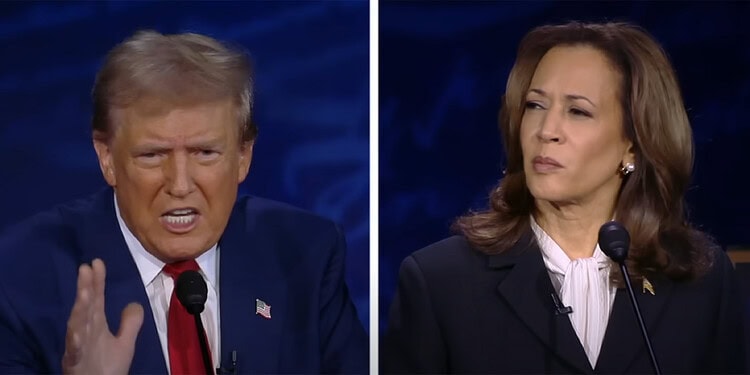

New research provides evidence that mainstream newspaper coverage of the 2024 United States presidential election focused heavily on political strategy and legal controversies rather than policy issues. The findings indicate that while coverage of Donald Trump was persistently negative, Kamala Harris received a temporary positive boost following her sudden nomination. The study was published in the Journal of Political Marketing.
The contemporary political environment in the United States is highly polarized, which shapes both how journalists report the news and how the public interprets it. During election years, readers flock to political news to inform their voting decisions. However, journalists face a choice in how they present this information. A 2011 review of political communication explained that news outlets often frame elections around campaign tactics, momentum, and horse-race polling—focusing on who is winning or losing—rather than substantive policy debates. When this strategy-based framing dominates, the news tends to emphasize political spectacle over practical governance.
Alongside this focus on campaign tactics, political news often carries a heavy dose of negativity. Journalists and readers alike tend to display greater sensitivity to conflict and scandal than to routine achievements. This negativity bias has become particularly pronounced in recent years. For instance, a study covered by PsyPost in 2023 found that negative language use among U.S. politicians surged starting in 2015 alongside Donald Trump’s initial primary campaign and remained elevated throughout his presidency.
The 2024 presidential election presented an unusually chaotic cycle, featuring an assassination attempt, a late-stage withdrawal by Joe Biden, and the rapid nomination of a new candidate, Kamala Harris. The authors of the new study set out to document how these unprecedented political shocks altered the narratives and the emotional tone presented in mainstream print journalism.
The research, led by Ayse D. Lokmanoglu of Boston University, analyzed tens of thousands of articles from five major high-circulation newspapers. The team focused on USA Today, The Washington Post, The New York Times, the Los Angeles Times, and The Boston Globe, collecting articles published between January 1, 2024, and January 31, 2025. After initially gathering over 500,000 articles, the researchers applied keyword filters to identify stories that specifically mentioned Joe Biden, Donald Trump, or Kamala Harris in the headline or opening excerpt. This process resulted in a final dataset of 37,321 full-text articles.
To make sense of this massive amount of text, the scientists used automated computer programs to conduct topic modeling and sentiment analysis. Topic modeling is a technique that identifies clusters of words that frequently appear together, allowing researchers to see what overarching themes are present in a set of documents without having to read each one manually. Sentiment analysis involves using a specialized dictionary to count the number of positive and negative words in an article, providing an overall score for the emotional tone of the text.
The researchers identified five major themes in the news coverage: elections and campaign frames, Trump family legal issues, domestic policy and regulation, foreign policy and ideology, and government and legislation. As the election cycle progressed, the share of articles dedicated to elections and campaign frames surged sharply. This spike was particularly prominent around major political events, such as Biden dropping out of the race and the Democratic National Convention.
Meanwhile, coverage of Trump’s legal issues grew steadily, peaking in late December and early January during developments in his various court cases. In contrast, discussions of domestic policy and regulation steadily declined in volume as the election approached. This pattern indicates a displacement effect, where campaign drama and legal scandals squeezed out substantive discussions of policy.
When looking at the emotional tone of the coverage, the researchers noted that the five newspapers converged on broadly similar patterns. Overall, the median sentiment of the coverage hovered slightly below neutral. However, distinct differences emerged depending on which candidate the article covered. Articles mentioning Trump were consistently negative throughout most of the pre-election period.
Articles mentioning Harris, or both Biden and Harris, trended in a slightly positive direction. Harris received a noticeable positive bump in coverage following the Democratic National Convention and the vice-presidential debate. This temporary boost aligns with the concept of a post-nomination honeymoon effect, where newly introduced or barrier-breaking candidates receive more favorable, optimistic coverage in their early days on the national ticket.
Interestingly, articles that mentioned both Democratic and Republican candidates were persistently negative, suggesting that when journalists write about both sides in the same article, they usually focus on partisan conflict and adversarial attacks.
The findings offer a detailed look at mainstream media narratives, but the researchers noted a few limitations to their work. The analysis focused exclusively on five major newspapers that generally lean toward the political center or center-left. Because the study excluded right-leaning outlets, the results might not capture the full spectrum of the American media diet.
Additionally, the automated tool used to measure sentiment relies on counting specific words, which means it can miss complex rhetorical devices like sarcasm, subtext, or strategic ambiguity. The researchers also filtered their articles by searching for specific candidate names. Articles that discussed broad political platforms or policies without naming Biden, Harris, or Trump directly were excluded, which could have artificially lowered the amount of policy coverage detected in the dataset. Future research could expand on this work by using advanced language models capable of understanding context and nuance, or by linking news publication data with social media metrics to see how readers amplify different types of political stories.
The study, “An Overview of Media Coverage Shifts Before and After the 2024 U.S. Presidential Election,” was authored by Ayse D. Lokmanoglu, Ananya Gupta, Tess Hemmila, Amira Jadoon, Bart Knijnenburg, and Arie Perliger.